This writing sample was produced for a RFP response to a public solicitation. This project approach was for developing a plan to have a fully electric bus fleet in the Town of Vail.
Fleet Maintenance Facilities & Electrification
Case studies1 conducted by transportation authorities throughout the US have found that maintenance facility requirements are generally similar for fully-electrified bus fleets compared to conventional transit vehicles. Agencies are ideally looking for battery electric buses (BEB) that can match the operating range and performance of traditional transit buses, since this would result in minimal impact to operations. While tooling and techniques may be different, facility envelopes and major equipment are likely to be compatible between technologies. Charging and electrical power infrastructure are recognized as a key focal point as large-scale deployments are considered.
Conventional buses can be refueled within a matter of minutes and can reenter service. BEBs, depending on battery, state of charge, and charging method, currently take between 2 and 4.5 hours using a high-rate charge to reach full capacity1. Our design will include the use of overhead and/or plug-in charging technologies to attempt to bridge this gap between conventional fueling rates and electric battery charging.
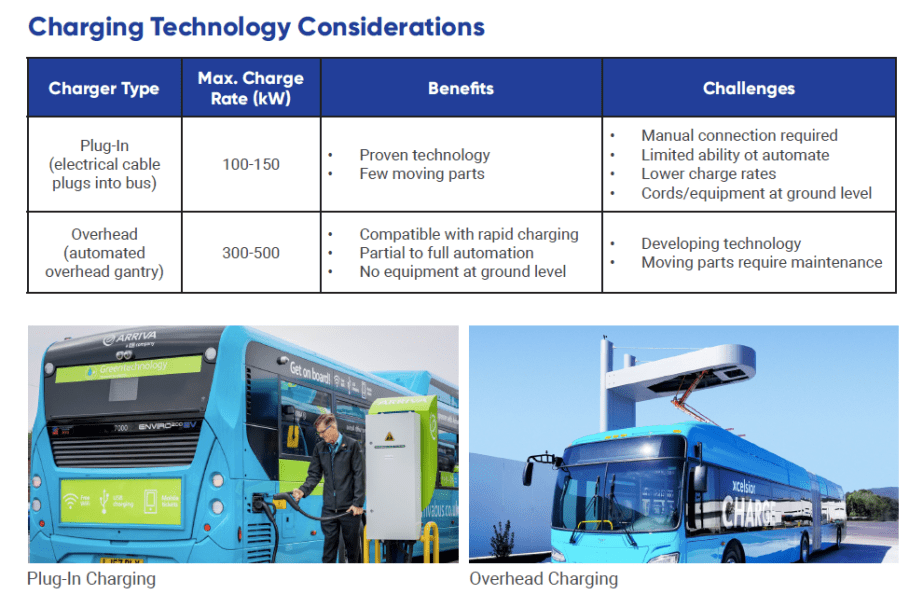
Considerations for Fleet Electrification
Associated Costs with Full Electrification
The utility costs of providing electrical power for an entire bus fleet should be carefully considered. A higher level of detail is needed when conducting a lifecycle cost analysis in order to fully understand the implications of increased utility bills for the Town of Vail. The life cycle cost analysis conducted by our team will require extensive conversations with Holy Cross Energy to understand peak demand and how the charging of buses will affect utility usage. Here are a few options to help minimize electricity costs:
Maximize available charging time: A fleet operating profile that maximizes the time available to charge (e.g., charging at lower power over a longer duration) generally will reduce electric costs.
More than one vehicle per charging station: Alternatively, a single, higher-power charging station (that reduces the time to charge each vehicle) could charge multiple EVs sequentially. From an electric rate perspective, this is like each vehicle getting its own lower power charging station, but the cost of infrastructure may be lower.
In general, the energy grid today has sufficient available capacity at the generation and transmission level to meet the needs of the additional electricity usage expected from electric fleets. At the local distribution level (where the electricity is delivered to the customer), additional upgrades may be needed to serve particular locations for EV fleet charging to address the increased demand for electricity. This is why early engagement with Holy Cross Energy is critical.
On-Site Renewable Energy
On-site renewable energy is an opportunity to help offset the cost of higher utility rates. A fleet charging station installation can be integrated with on-site generation or on-site energy storage. These systems can reduce the net energy peak that the electric company sees at the meter, for example. Our project team will review the Solar Site Analysis provided by the Town of Vail and use every opportunity to incorporate on-site solar into the final design solution.
Software
Electrical vehicle charging stations are still a relatively new technology and therefore, software options to support these charging stations are limited. Software licensing requirements are costly and need to be incorporated in the overall project budget and long-term operational costs. Low voltage infrastructure and proper allocation of a network will be required.
Anticipated Future Fleet Requirements
MEP understands that the existing electrical service for the Public Works Shop will need to be redesigned to not only accommodate the current conversion but anticipate future loading as the bus fleet transitions from diesel to electric over time. Our team will need to review the appropriate Master Plan documents to confirm the desired path for planning for future expansion. This can be provided at the main electrical switch gear and through installed conduits for future charging locations, as shown in the example below.
Emergency Back-up Power
The energy grid is highly reliable, with average uptime greater than 99.9 percent. While disruptions do occur on occasion, it is important to distinguish between different outage types. Short-duration outages (e.g., 15 minutes or less) are not likely to cause a major disruption to fleet operations that have a multiple-hour window in which to charge. Longer-duration outages, such as those that may occur following a severe weather event, could be disruptive to operations. Because of this, the addition of appropriately sized generator(s) will be a critical part of design. This will be different than standard electrical generators in which “critical” loads are connected to the generator. MEP Engineering and team will work with the Town of Vail to understand what a “critical” quantity of buses would look like and how the generator(s) are sized.
 Lauren Richey